What happens when oxygen and CO stop following their usual inverse relationship? The trend from this wood-products boiler shows why a single reading rarely explains a combustion upset.
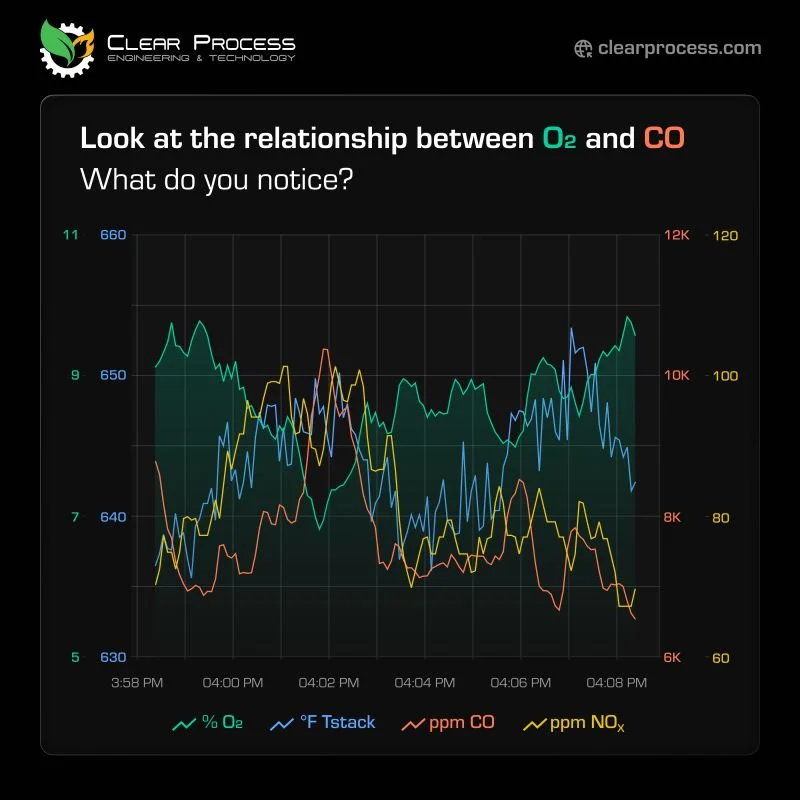
During the upset around 4:00 PM, oxygen fell sharply while CO increased and stack temperature rose. Later, the relationships changed again as the system responded. Treating the entire trace as one steady condition would miss the event worth investigating.
The investigation focused on fuel distribution, combustion-air mixing, control response and furnace draft. Biomass moisture and particle size can change how fuel accumulates and burns, making those interactions particularly important.
NOx and temperature provide supporting evidence, but neither proves a root cause on its own. Align the trends with feeder changes, damper movement and load, and account for analyzer response delays before deciding which signal led the event.
CPE's combustion assessments combine these trends with field observations to identify the underlying constraint and make adjustments that address it.