Improper conveying air temperature control in dry sorbent injection systems doesn't just reduce efficiency - it cements reagent to the convey-pipe walls.
Yet proper conveying air cooling is commonly overlooked or neglected, creating massive operational problems at facilities worldwide.
Temperature control is just one of several critical factors that determine whether a DSI system operates efficiently (or becomes a maintenance nightmare).
What is dry sorbent injection?
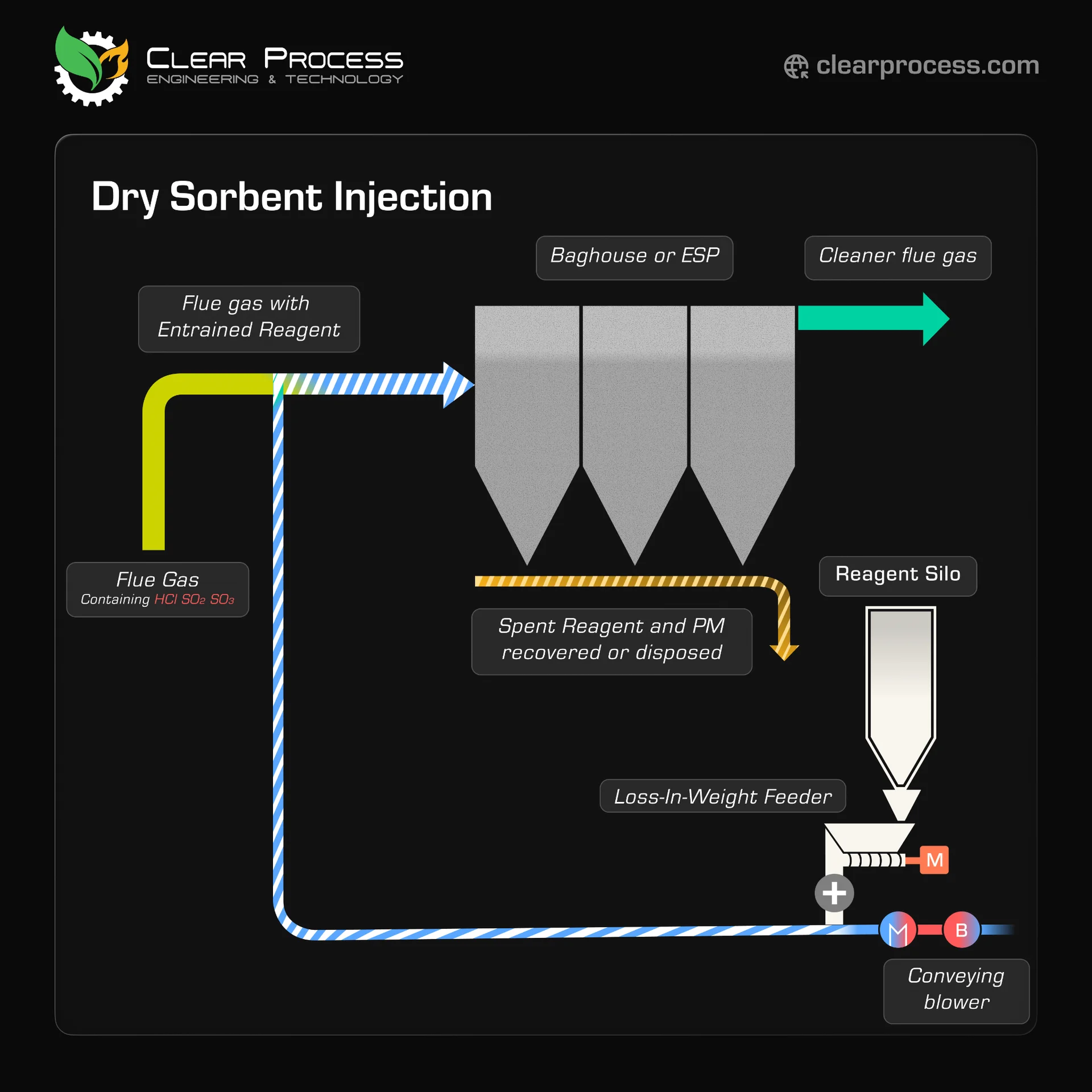
Dry Sorbent Injection (DSI) is a process technology that reduces acid gases - particularly HCl, SO₂, and SO₃ - from industrial flue gas streams by injecting dry alkaline sorbents (typically sodium or calcium-based) that react with acid gases to form solid particulates captured downstream in baghouses or ESPs. Properly designed and operated DSI systems can achieve acid gas emission reductions between 80 and 95%.
3 factors determine system effectiveness
1. Reaction time
Most systems require ~2 seconds minimum for effective acid gas conversion. Injecting too close to the particulate control device significantly reduces acid gas reduction efficiency and over consumes sorbent.
2. Flue gas temperature
Temperature affects reaction kinetics and sorbent utilization. Too hot or too cold, and the sorbent consumption increases while acid gas reduction efficiency decreases.
3. Mixing
Poor distribution across the injection-point duct cross-section creates stratified zones where sorbents don't mix and react with the acid gases. Proper injection nozzle design and placement are essential for achieving uniform mixing and achieving the required acid gas reduction.
Baghouses typically yield a higher acid gas reduction while using less sorbent. This is because the bags become coated in a thin layer of sorbent, which increases the exposure of the sorbent to acid gases.
Common DSI applications
- Biomass & waste-to-energy facilities
- Municipal solid waste incinerators
- Coal-fired boilers
- Industrial processes with acid gas emissions
The process flow diagram below shows a typical DSI configuration.
Something else often overlooked?
Sorbent storage and handling systems are just as important as the injection/distribution system itself. Moisture infiltration, bridging in silos, particle size distribution, and inconsistent feed rates can undermine even the best-designed DSI system.