Reducing NOx usually comes with a penalty: higher unburned carbon and CO. The Overfire Air (OFA) system is the engineering solution designed to break that trade-off.
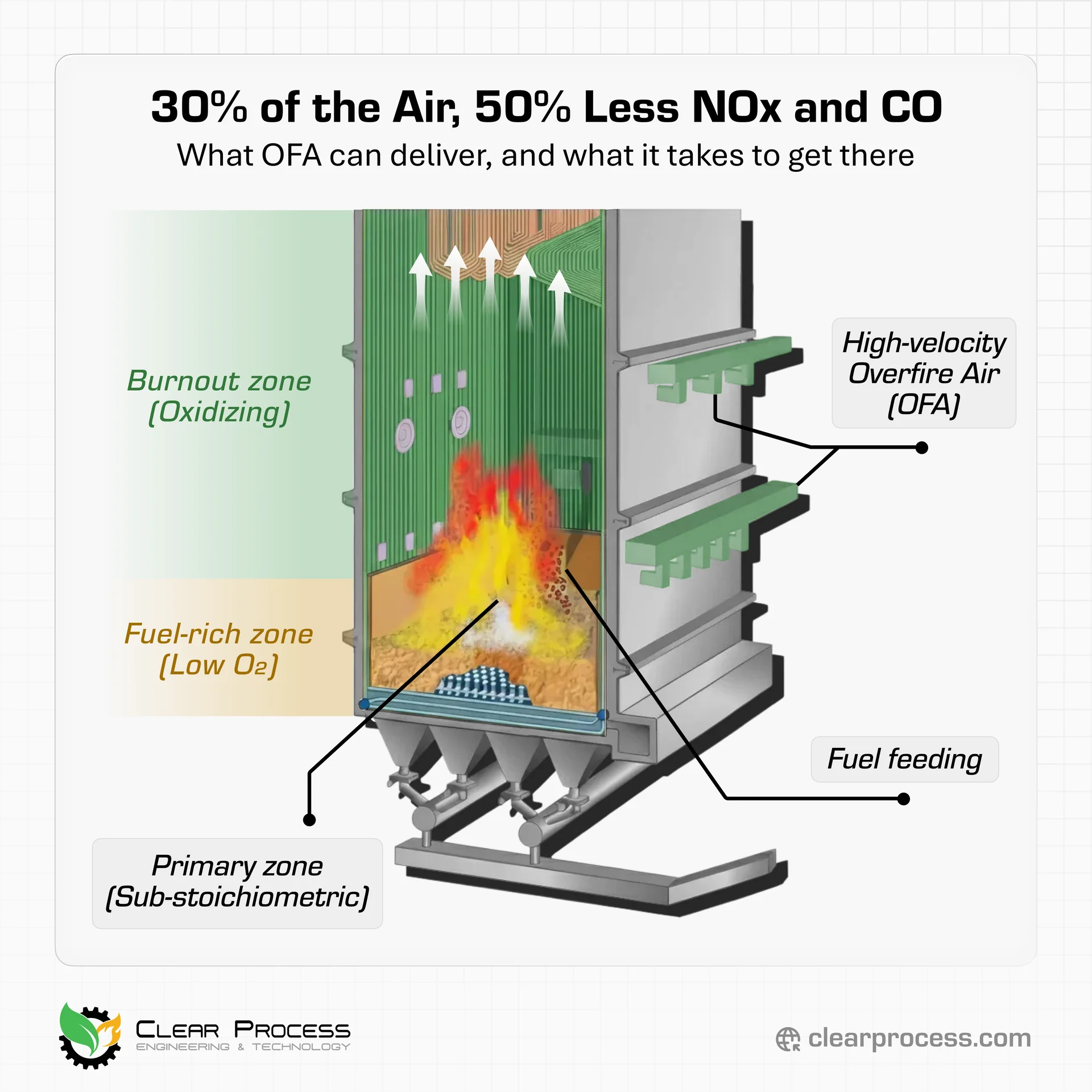
An Overfire Air system reduces NOx formation by staging combustion. Instead of dumping all the combustion air into the primary combustion zone, a portion (typically 25-40%, but as high as 60-70% in some designs) is introduced in zones above the primary combustion zone.
In a well designed, flexible OFA system, boiler operators have options for making air adjustments when fuels change (moisture content, fuel particle size, and more) without compromising production or emissions compliance.
How Staged Combustion Works
1. Primary Zone (Sub-Stoichiometric): The primary combustion zone operates fuel-rich (starved of air). This limits the oxygen available for volatile release while providing just enough for efficient fixed carbon burnout, which lowers the primary zone's peak and average temperatures - and with them, thermal NOx.
2. OFA Zone (Burnout): The remaining combustion air - enough to reach furnace exit oxygen concentrations between 2.5% and 7.5% - is introduced at high velocity through ports at multiple elevations above the primary combustion zone. This creates an oxidizing environment with high turbulence and mixing that completes the combustion of CO and remaining char before the gas enters the convection passes.
Location, Turbulence, and Penetration
For biomass and waste fuels especially, simply adding air ports isn't enough. You need location, turbulence, and penetration.
If the OFA velocity is too low, the air hugs the furnace walls while the fuel-rich gas channels up the center. This stratification produces the worst of both worlds: high emissions and poor efficiency. Effective OFA systems use high-pressure fans and specific nozzle geometries to punch through the gas stream and ensure turbulent mixing across the entire furnace cross-section.
What a Well-Designed OFA System Delivers
A well-designed OFA system lets you meet strict NOx permits with less spent on post-combustion controls, while significantly reducing CO and LOI (Loss on Ignition) - typically achieving CO below 100 ppm and LOI under 5%.
The OFA system also serves as the oxygen trim control in many applications, ensuring there is always enough oxygen to maintain stable, safe combustion.
Does your facility struggle with balancing NOx and CO emissions compliance against combustion efficiency?